




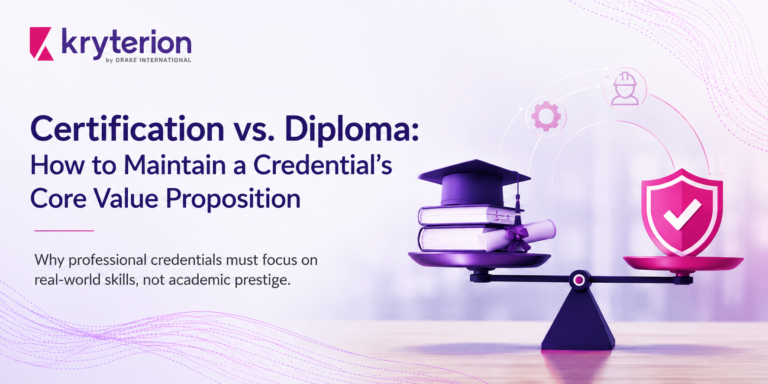
A university diploma and a professional certification are fundamentally different tools designed to solve fundamentally different problems. While academia builds broad, theoretical foundations over years of study, the credentialing ecosystems are built to answer one immediate, urgent question: Can this person safely and effectively execute the job today?
However, a dangerous and growing trend is emerging across the certification landscape. Professional and trade credentials are increasingly trying to mimic traditional academic degrees in a misguided quest for prestige or perceived rigor. Certification bodies are replacing their practical, job-ready focus for institutional formality.
When a credential attempts to act like a university degree, it fundamentally loses its core value proposition. Let’s take a look at why trade and professional certifications must lean into what makes them uniquely powerful, rather than playing by academia’s fundamentally different rules.
The Allure of Academia
The pressure to academicize a credential often comes from a well-meaning place. Program directors want their certifications to be respected in the industry they serve. They face what is sometimes called “degree stigma,” which is the societal bias that views four-year university degrees as the gold standard of professional achievement.
To combat this, credentialing boards sometimes inflate their programs. They do this by adding layers of generalized theory to their exam blueprints, mandating broad prerequisites that have little to do with the daily realities of the job, and structuring their assessments to test historical knowledge or abstract concepts rather than applied, situational problem-solving. Unfortunately, this is a trap.
A university is designed to create well-rounded thinkers over a multi-year journey. Conversely, a credentialing program is designed to verify immediate, specialized competence. When an exam asks a construction worker to write a short essay on the history of architecture rather than asking them about how to ensure safety, rescue costs, and deliver programs and projects on time, the credential has lost the plot. It has alienated the workforce it was built to serve and betrayed the employers who rely on it for technical validation.
Employer Trust vs. Institutional Formality
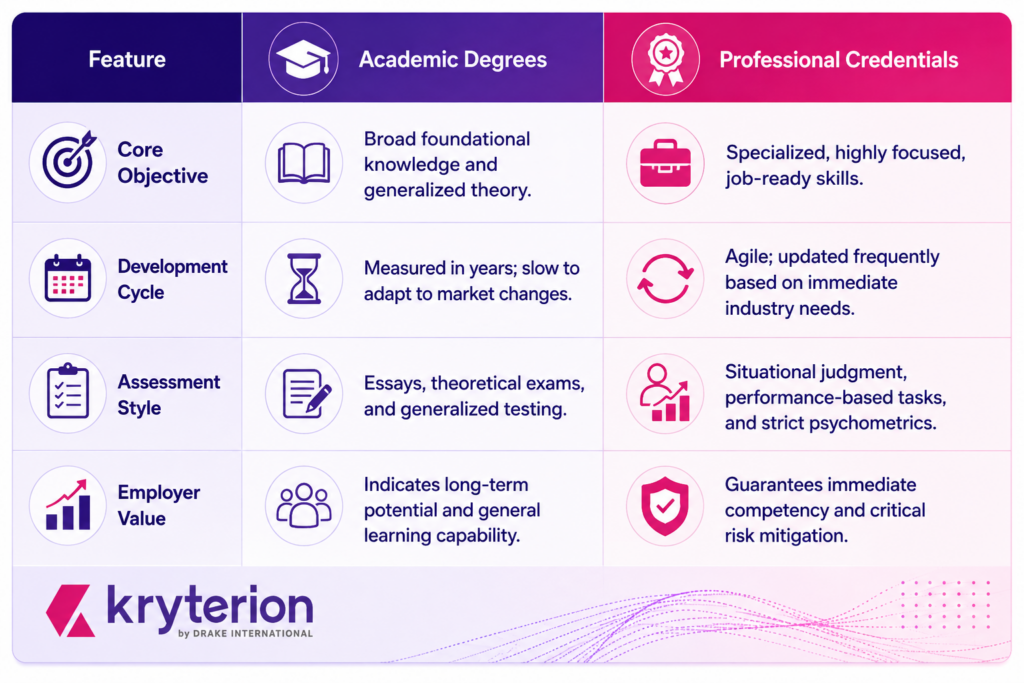
To understand why this distinction is so vital, we must look at how hiring actually happens in fast-moving and high-risk sectors. Academic degrees provide a broad, theoretical foundation designed for long-term career mobility and general knowledge. They are built on institutional formality, such as credit hours, general electives, long semesters, and extensive theory.
Employers do not look at a trade credential or a professional certification to see if a candidate is well-rounded or culturally literate. They look at it to answer one, highly specific question: Can this person execute the required tasks safely, securely, and effectively today?
When certification bodies inflate their programs with tangential theory to seem more rigorous, they actively erode employer trust. After all, employer trust isn’t built on academic prestige. It’s built on the reliable assurance of specific, applicable competencies.
If an organization is hiring an HR Manager, they care about whether the candidate knows HR state-specific laws, not the general theory of human relations. The same goes for Project Managers. Can they use their knowledge to improve project delivery success rates?
Real-World Verification That’s Legally Defensible
Academia often measures success through subjective means, including term papers graded by teaching assistants, open-ended philosophical debates, and cumulative GPA. A defensible trade or professional credential requires something entirely different. They look for strict, objective, real-world verification.
That’s why the assessment must accurately mirror the actual working environment. This is where the science of psychometrics comes into play. A legally defensible credentialing program must be built on a rigorous Job Task Analysis (JTA). The JTA is the antithesis of a university syllabus. Instead of a professor deciding what they feel is important to teach, a JTA relies on Subject Matter Experts (SMEs) to dissect the profession into specific domains, tasks, and knowledge statements.
By testing exactly what a practitioner does in the field, you ensure the credential has content validity. You verify capability, rather than just the ability to memorize theoretical concepts. Furthermore, certification exams utilize sophisticated standard-setting methods to determine the exact cut score that separates a competent practitioner from an incompetent one. Academia grades on a curve while credentialing grades on absolute public safety and occupational competence. Pretending the two are the same is a disservice to candidates and employers alike.
Avoiding the Expiration Date
Perhaps the most significant flaw in treating a professional certification like a university degree is the concept of permanence.
A bachelor’s degree in computer science earned in 2005 is valid forever. The university will never revoke it, nor will they ask the alumni to come back and prove they still know how to code. But what value does a 2005 computer science degree hold when evaluating a candidate’s ability to manage modern day technologies or cloud infrastructures? The honest answer is very little.
Many trades evolve at a breakneck pace. The half-life of learned skills in these sectors is shrinking rapidly. Trade and professional credentials derive their immense market value precisely from their time-based validity, including:
- Enforced Relevance: Expirations and stringent Continuing Education (CE) or Maintenance of Certification (MOC) requirements ensure that the certificant’s skills are up-to-date. They force the professional to stay current with newly released software updates, revised medical regulations, and updated safety codes.
- Market Confidence: Employers inherently trust active credentials because they represent current competence, not historical achievement. When a credential has a strict two-year or three-year renewal cycle, the employer knows they are mitigating present-day risk.
Pretending a professional certification is a one-and-done academic achievement degrades the integrity of the program. If a certification body allows its credential to last a lifetime without recertification, it’s admitting that the credential is merely a piece of paper, not a living guarantee of skill.
The Impact on Key Industries
The need to separate credentialing from academics is important not just with professional and trade credentials, but also with other major sectors that rely heavily on robust assessment and test delivery ecosystems.
1. Technology and SaaS Ecosystems
The tech industry is the poster child for skills-based hiring. Tech giants and SaaS providers update their platforms constantly. An IT professional who passed a cloud architecture exam three years ago is dealing with a fundamentally different platform today. Tech credentials must avoid academic theory in favor of performance-based testing.
2. Healthcare and Medical Boards
In healthcare, the stakes are literal life and death. Medical boards and nursing associations cannot afford to dilute their exams with non-important academic theory. The focus must remain aggressively on patient safety, strict protocol adherence, and situational judgment. When a nurse is taking a certification exam, the items must reflect the high-pressure triage decisions they will make on the floor.
3. The Skilled Trades
Electricians, plumbers, HVAC technicians, and welders keep the physical infrastructure of society functioning. Trade credentials are the ultimate proof of applied physics and mechanical skill. If a trade union or association tries to academicize their journeyman exams, they fail their members. Trade credentials must remain practical, utilizing strict blueprint reading, code compliance testing, and physical or simulated performance validations.
4. Professional Associations
From financial planners and HR professionals to project managers and supply chain experts, professional associations use credentials to define the gold standard of their respective industries. These associations must constantly resist the urge to turn their certifications into mini-MBAs. A project management credential is only valuable if it proves the holder can manage budgets, timelines, and personnel today, adapting to new agile methodologies and labor laws. Mandatory recertification keeps these association members at the top of their game and maintains the prestige of the association itself.
Protect Your Credential’s Core Value
To maintain their role in the modern workforce, credentialing bodies must stop chasing the shadow of traditional academia and double down on their true purpose, which is verifying immediate, job-ready competence. Moving forward, test program directors must protect their core value proposition by knowing what to do, and, equally as important, what not to do.
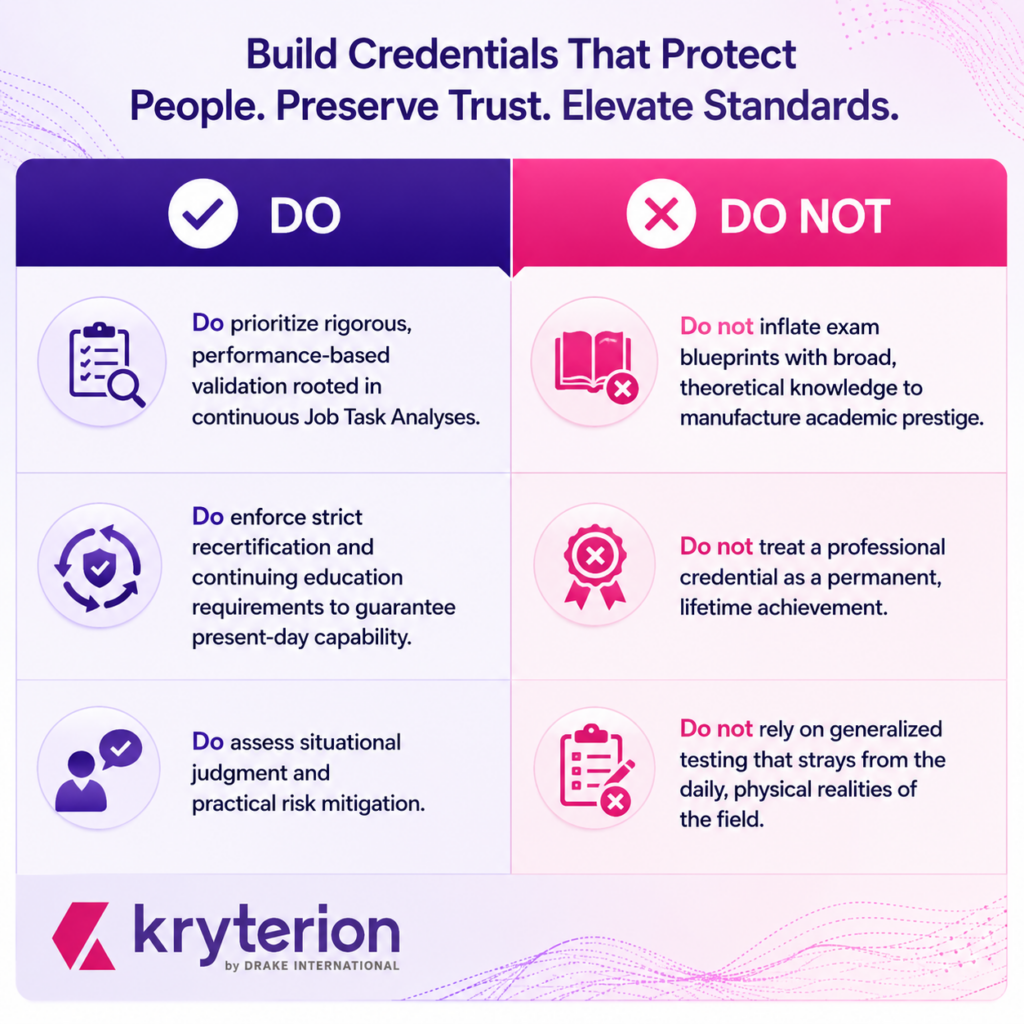
Ultimately, a professional certification is not a mini-degree and it shouldn’t try to be. By rejecting the academic model and leaning into agility, real-world application, and time-bound validation, your credentialing program will remain a powerful, living guarantee of skill that employers, candidates, and the public can unconditionally trust.
About Kryterion
Kryterion Inc. is a global leader in innovative testing and credentialing solutions. We help organizations across various sectors develop and manage their assessments with our advanced test development platform and multi-modal delivery solutions. Established in 2001 Kryterion offers secure and integrated services along with extensive support. This empowers candidates to demonstrate skills and achieve success in world class careers.