
A successful credentialing vendor implementation is essential for maintaining compliance and quality across your organization. Whether you manage medical privileges in healthcare, track technical certifications, or oversee continuing education units, this process protects your reputation while verifying that professionals remain qualified.
When it’s time to upgrade or replace your credentialing software, the stakes are universally high. Transitioning to a new vendor is like rebuilding an airplane while it’s in flight. Leadership teams naturally focus on the tangible metrics: API integrations, feature parity, budget approvals, and go-live timelines. However, the most critical factor determining the success of a new implementation cannot be found on a project management dashboard. That factor is organizational trust.
When you disrupt the systems that certification managers, IT administrators, and specialized professionals rely on daily, you are asking for a massive leap of faith. Mishandling this transition creates friction that can derail even the most sophisticated technology.
If your organization, whether it’s a healthcare, tech enterprise, or industry association, is preparing to make a switch, here is a blueprint for implementing a new credentialing vendor while maintaining the absolute trust of your stakeholders.
Internal Trust Erosion During Vendor Change
In executive boardrooms, changing a vendor is viewed as a strategic win. It represents a move toward better automation, robust analytics, and streamlined workflows. But for the operational teams on the ground, such as the credentialing specialists, compliance officers, and program managers, a vendor change often triggers anxiety.
This silent erosion of internal trust begins the moment a transition is announced. Staff may remember past software rollouts that promised efficiency but instead delivered months of weekend overtime and broken processes. They worry that the new system will drop critical applicant files, destroy their workflows, or even render their roles obsolete through automation.
When leaders ignore the psychological toll of system migration, trust evaporates. Staff may comply out of obligation, but no one can blame them if they’re feeling skeptical.
To prevent this erosion, it’s important to acknowledge the human element of technology adoption. Bring those most likely to be affected into the process early. Validate their operational concerns, be completely transparent about the learning curve, and emphasize that the new software is a tool designed to empower their expertise, not to overwrite it.
Governance-First Implementations
The fastest way to fracture trust during a credentialing migration is to treat it purely as an IT initiative. It’s an operational and compliance transformation that happens to be enabled by technology.
When organizations rush to configure software without establishing clear rules of engagement, workflows become chaotic. Legacy processes from the old system get jammed into the new vendor’s framework. Decisions regarding data architecture, user permissions, and nomenclature are made on the fly by technical analysts who might not grasp the complex bylaws of your professional association or the strict regulatory mandates of your industry.
The solution is a governance-first implementation. Before beginning the transition, it’s crucial to establish a steering committee representing a cross-section of your Ideal Customer Profiles (ICPs) and internal stakeholders. Governance means setting the rules before the work begins.
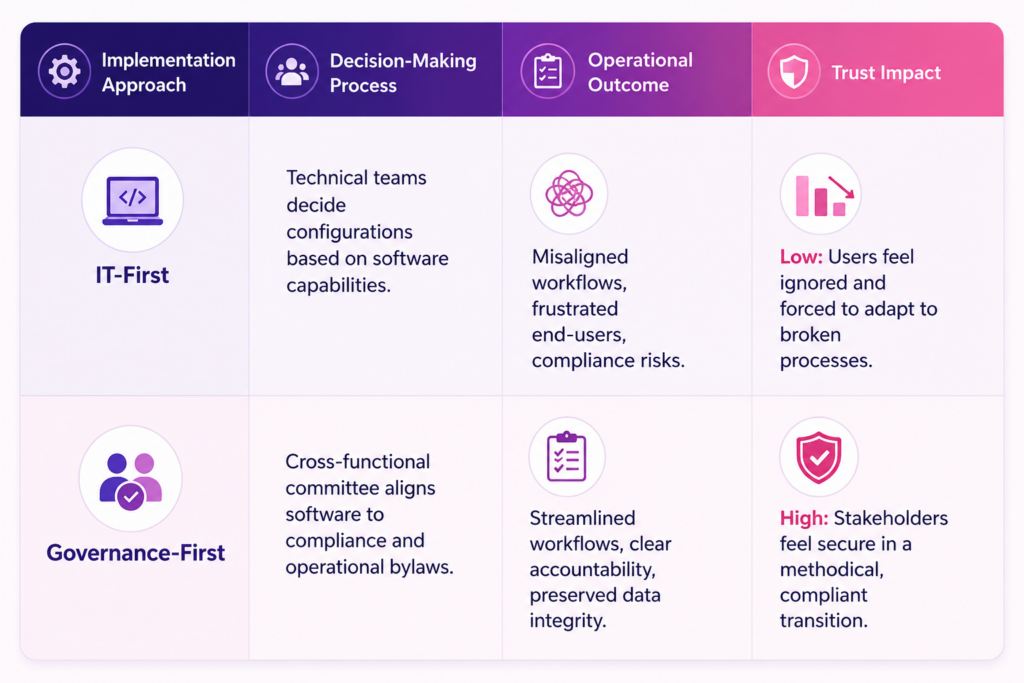
Governance requires answering tough questions early. Who holds the final sign-off for workflow changes? How will the organization handle data before the transfer? Establishing these rules methodically builds immense trust, proving to your team that compliance and quality are not being sacrificed for an arbitrary IT deadline.
Data Migration Does Not Equal Data Continuity
There is a critical distinction in software implementations that is often misunderstood. Moving files from System A to System B is a technical task known as data migration. Ensuring that a professional’s complex certification history, historical audit logs, and upcoming expiration dates remain accurate and actionable in System B is data continuity.
Imagine transferring a professional’s profile from an old database to a new one. The technical migration successfully moves 200 PDFs, a unique ID number, and an expiration date. The IT dashboard reads: 100% data transferred. However, when the credentialing manager logs in, they discover the new system interprets the Active-Pending status differently than the old one. The data successfully migrated, but its operational context was destroyed. Automated alerts for expiring certifications are suppressed because the fields did not map logically.
When data continuity fails, the fallout is severe. Tech professionals might lose access to secure systems, healthcare providers might face delayed privileges, or association members might have their hard-earned credentials improperly revoked.
It’s necessary to bridge this gap by investing heavily in logical data mapping and context-based testing. You can’t just test if the data arrived. You also need to test if the software reacts correctly to that data. Run parallel audits where credentialing experts manually verify a statistically significant sample of profiles, so that the narrative of each individual’s credentialing journey remains perfectly intact.
Stakeholder Communication Cadence
In a vacuum of information, stakeholders assume the worst. A poorly planned communication strategy during a vendor switch breeds rumors and frustration. However, untargeted over-communication can be equally harmful. If you flood your busy professionals with highly technical backend updates, they will ignore your emails, and they will miss the critical message containing their new login credentials.
Building trust requires a calibrated communication cadence tailored to the specific needs of distinct audiences:
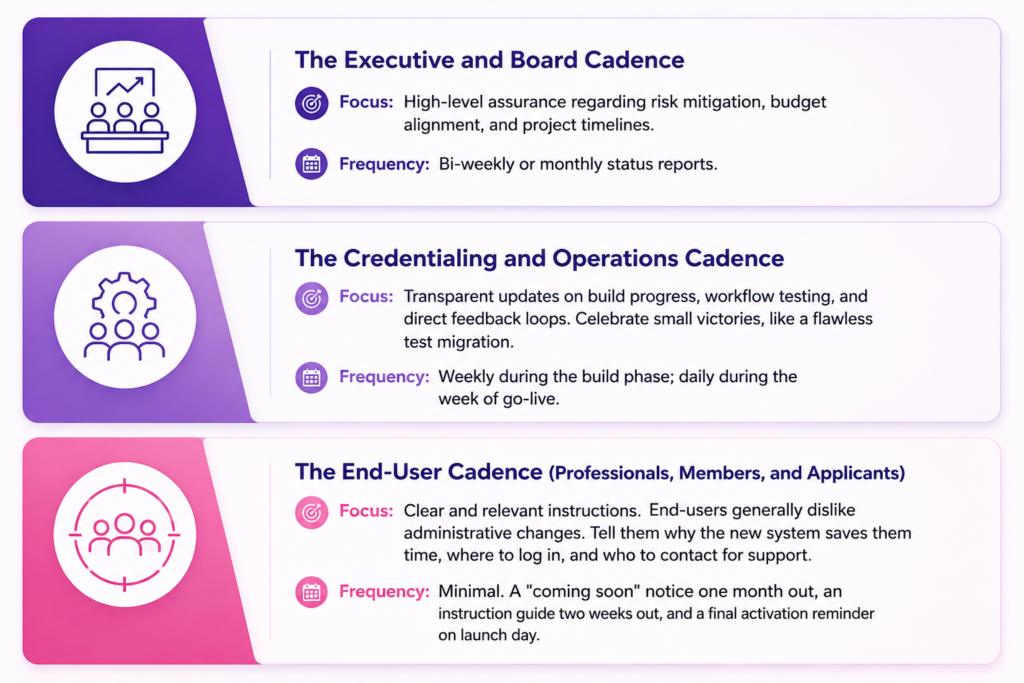
Targeted, predictable, and honest communication proves you are managing the transition competently, cementing organizational confidence.
Quiet Failures During Go-Live, And How Leaders Spot Them Early
You’ve reached go-live. The new software is activated, the servers hold up, and there are no immediate crises. The implementation team declares a victory.
However, silence does not equal success. The most dangerous threats to a new credentialing system are quiet failures. A quiet failure occurs when the system functions perfectly from a technical standpoint, but the operational reality for the user is fundamentally broken.
It’s the compliance specialist who realizes a standard background verification now requires fifteen clicks instead of four, halving their daily productivity. Or, it’s the association board member who cannot figure out the new approval portal and simply starts ignoring system notifications. It could also be the invisible, slow-moving buildup of application backlogs that will not be discovered until a major revenue or compliance bottleneck hits three months later.
If leaders wait for a massive operational crisis to identify these flaws, trust in the new vendor is already lost. Astute leaders hunt for quiet failures proactively:
- Watch for Spreadsheet Reversion: If you catch staff minimizing the new platform to log dates in a personal spreadsheet, the workflow has failed. Users only revert to manual tracking when the system is too cumbersome to trust.
- Monitor System Audit Logs: Do not rely solely on qualitative feedback. Look at the data. Are users actively logging in? How long do applications sit in pending status compared to historical averages? A spike in processing time is a glaring red flag.
- Host Open Office Hours: In the weeks following launch, hold unstructured virtual drop-in sessions. Allow users to screen-share their daily tasks and voice frustrations. Often, a quiet failure can be solved with five minutes of targeted shortcut training.
Securing Your Operational Future
Changing your credentialing vendor is a high-stakes pivot that demands technical precision, rigorous operational governance, and genuine empathy for the people navigating the disruption. By anticipating the erosion of internal trust, demanding data continuity over simple migration, adhering to strict communication cadences, and hunting down quiet failures, you transform a risky software rollout into an operational triumph.
You don’t have to navigate the complexities of system migration and vendor evaluation blindly. Whether you are managing professional association members, technical certifications, or healthcare credentials, understanding the distinct phases of change management is critical.
Kryterion can help you explore the definitive roadmap for a seamless software transition. Dive deeper into our strategies, vendor evaluation frameworks, and best practices by visiting Kryterion’s Changing Vendors Pillar Page. Equip your team with the insights required to make your next implementation an undeniable success.