Why Exam Security Matters More Than Ever

As certification programs continue to move online and adopt hybrid delivery models, exam security has become more complex than ever before. At the same time, the rapid adoption of artificial intelligence (AI) has transformed both how exams are protected and how cheating occurs. Generative AI, remote collaboration tools, and identity spoofing technologies have introduced new threats to the integrity of exams.

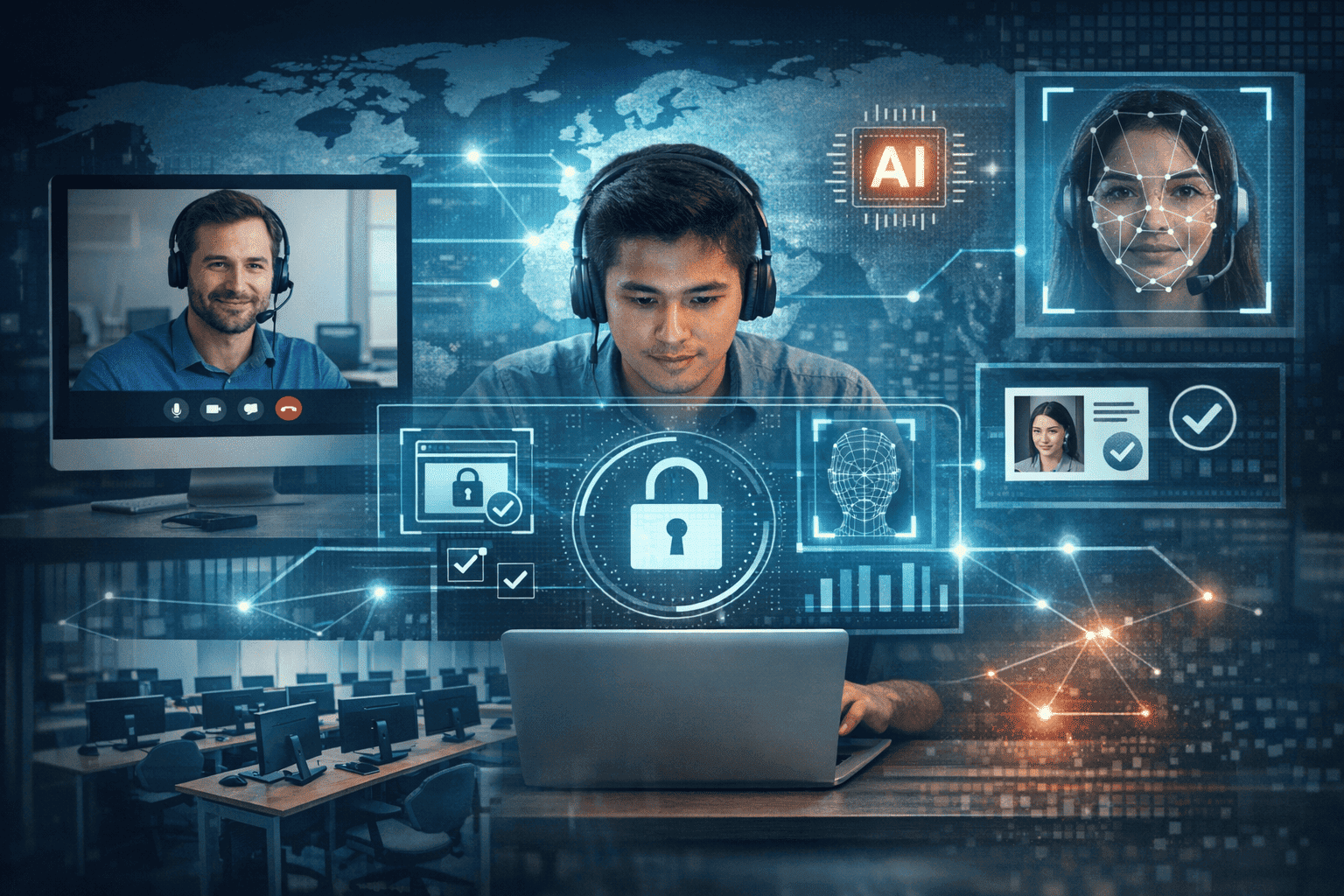
For high-stakes certification programs, exam content theft does not just compromise an individual test; this risk threatens brand credibility, regulatory compliance, and candidate trust. Today’s organizations must evolve from basic monitoring to layered exam security strategies
that combine AI detection, human oversight, biometric verification, and secure exam environments.

Kryterion helps organizations stay ahead of AI-era risks with multi-layered security solutions that protect certification integrity across online, in-person, and hybrid delivery models.

Table of Contents

What Is Exam Security in Modern Certification Programs?

Exam security refers to the systems, processes, and technologies used to prevent cheating, protect exam content, verify candidate identity, and ensure fair, consistent testing outcomes. In today’s digital-first environment, exam security must extend far beyond a locked testing room or a live proctor.

Modern exam security includes:

  • Remote and in-person proctoring
  • Biometric identity verification
  • Browser lockdown and device controls
  • AI-powered exam session monitoring
  • Secure data handling
  • Audit trails and exam session review

As certification programs expand globally and candidates test from anywhere, exam security has shifted from a single control point to a multi-layered defense system designed to protect both the exam sponsor and the candidate experience.

The Biggest AI-Era Threats to Certification Integrity

AI has introduced entirely new categories of risk for certification programs, fundamentally changing how cheating occurs and how organizations must respond.

AI-Assisted Cheating now enables candidates to generate real-time answers, instantly summarize complex technical concepts, and bypass traditional knowledge testing through the use of generative tools during an exam session.

Proxy Testing & Identity Fraud has become more sophisticated through deepfake identity spoofing, remote proxy test-takers, and credential sharing, making identity verification a critical security layer.

Virtual Machines & Screen Sharing allow candidates to run hidden operating systems, mirror exam content to outside collaborators, or use secondary devices undetected – making basic monitoring systems obsolete.

Content Theft & Item Harvesting poses a serious long-term threat when exam questions are copied, reconstructed using AI, and resold on exam prep websites, eroding the integrity of certification programs.

These evolving threats demand continuous security innovation, not static rules or one-time controls.

The Core Pillars of Secure Exam Delivery

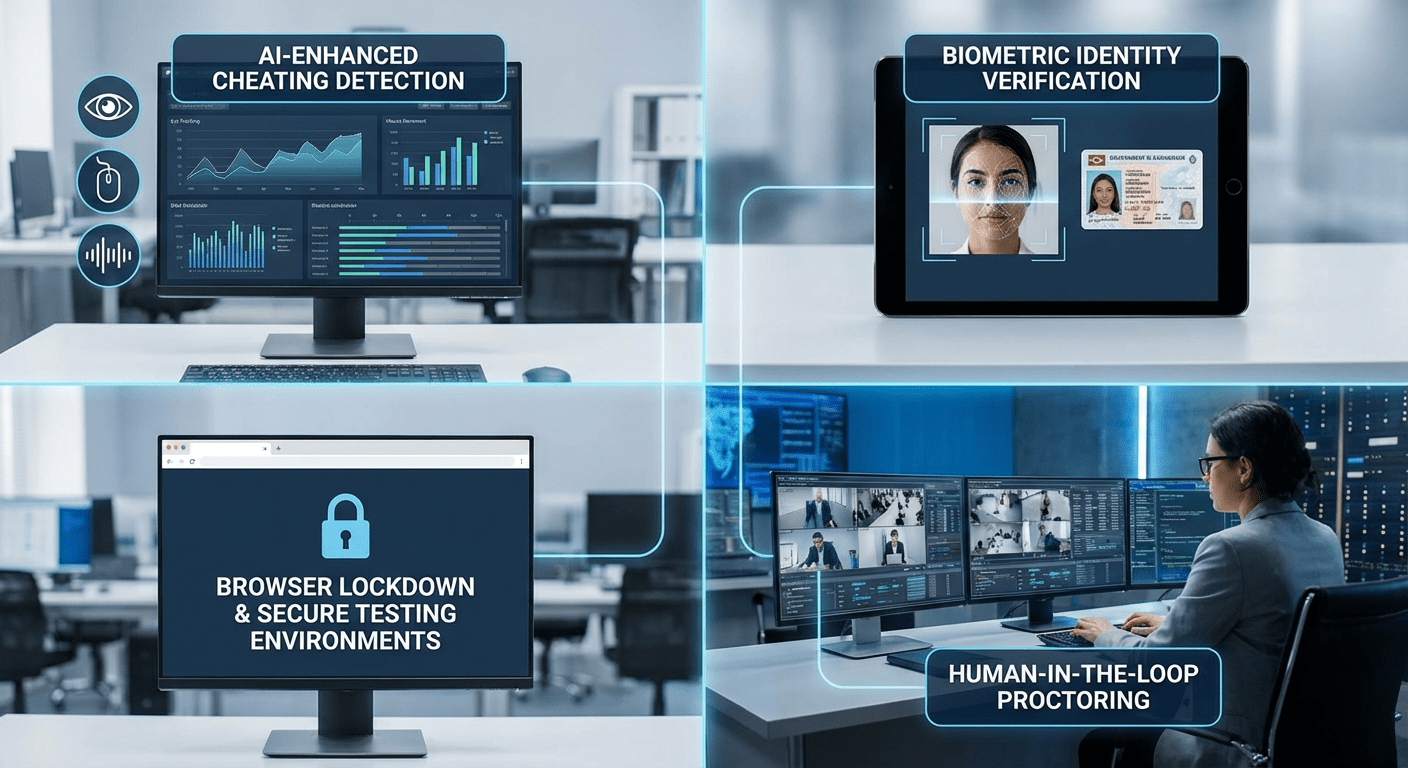
AI-Enhanced Cheating Detection uses behavioral analysis such as eye movement, mouse behavior, environmental visual and audio, and navigation patterns to identify suspicious activity. This allows test sponsors to detect rule violations at scale.

Browser Lockdown & Secure Testing Environments prevent candidates from accessing other applications, screen capture tools, external websites, or virtual machines during an exam session. This gives test sponsors more control over test environments, even remotely.

Biometric Identity Verification strengthens candidate authentication through government ID checks, facial recognition, and multi-factor verification. These tools prevent proxy testing and confirm that the registered candidate remains present throughout the exam.

Human-in-the-Loop Proctoring pairs AI risk detection with trained human reviewers who confirm intent before taking action. This approach reduces false positives, minimizes candidate frustration, and mitigates algorithmic bias which benefits both strong exam security and fairness.

Security, Fairness, & Candidate Trust

Strong exam security must protect certification integrity without undermining the candidate experience. Overly aggressive monitoring or poorly calibrated AI systems can introduce unintended consequences such as increased candidate stress, accessibility barriers, and potential bias.

The most effective security programs balance advanced enforcement with human judgment. It is also essential for test sponsors to have transparent communication about their security best practices and use of AI-enhanced technology. When candidates understand how monitoring
works, how their data is protected, and how decisions are reviewed by humans, trust increases.

Fair and secure exams don’t just deter misconduct, they strengthen program credibility. This improves candidate confidence and reinforces the long-term value of the credential. True exam security protects both the exam and the people taking it.

Data Privacy, Compliance, & Regulatory Readiness

As certification programs expand globally, data privacy and regulatory compliance are critical. Certification platforms must safeguard sensitive candidate data while meeting the requirements of evolving regulations such as GDPR, SOC 2, ISO/IEC standards, and regional privacy laws.

Effective exam security extends beyond monitoring behavior; it includes encrypted exam content, secure video storage, restricted access controls, and complete audit trails. These protections safeguard candidate information by handling it responsibly and protect organizations from negative regulatory reviews or legal scrutiny.

Kryterion’s compliance-first security approach helps organizations deliver exams with confidence across borders, reducing risk while protecting both institutional reputation and candidate trust.

How Kryterion Delivers Secure, AI-Ready Exam Programs

Kryterion protects certification programs through a multi-layered exam security ecosystem designed for today’s AI-driven threat landscape. At the core is Webassessor®, Kryterion’s secure exam delivery platform, which supports online, in-person, and hybrid testing at scale.

Online live proctoring with Kryterion’s Webassessor® includes AI-enhanced monitoring in real time, while live human proctors provide critical oversight to validate intent and fairness.

To further secure the testing environment, Kryterion delivers a multi-layered security approach that includes:

  • Secure Browser lockdown and device controls that prevent unauthorized access to applications, screen-sharing tools, and external resources during the exam.
  • AI Guided Pre-Check identity verification, including ID authentication and facial recognition, to prevent proxy testing and monitor so only the registered test candidate is present throughout the exam session
  • Encrypted item banks and detailed audit trails protect exam content and support regulatory compliance.

This entire ecosystem is supported by a global secure test center network, giving organizations maximum flexibility without sacrificing control.

Together, these layers encourage organizations to scale certification programs globally without increasing security risk.

FAQs: Exam Security & AI in Certification

  1. How does AI proctoring detect cheating?
AI proctoring evaluates patterns such as movement, gaze, audio cues, and navigation behavior to identify high-risk anomalies that may signal potential cheating behaviors for further review. 
  1. Is AI proctoring biased?
AI systems can reflect bias if not carefully monitored. Kryterion Online Live Proctoring pairs AIenhanced technology with human-in-the-loop review and remote proctor oversight to support fairness and accuracy. 
  1. Is online exam security as strong as in-person testing?
Online exam security can be as strong as, or even stronger than, in-person testing when layered properly. Hybrid exam security models often exceed traditional test center controls. 
  1. How is candidate privacy protected?
Candidate privacy is protected through encrypted data, restricted access controls, and systems that comply with global privacy regulations such as GDPR and SOC 2. 
  1. What industries require the highest exam security?
Technology, finance, healthcare, and regulated industries often have high-stakes certifications that require the highest exam security. 

Next Steps: Secure Your Certification Program with Kryterion

As AI continues to evolve, exam security must evolve with it. Organizations choose Kryterion because we uniquely combine advanced AI-enhanced security, human proctoring with highly trained experts, psychometric validation, and a global test delivery infrastructure to protect
certification integrity at every level. If you’re ready to future-proof your program against emerging threats, now is the time to act.

Connect with a Kryterion security expert

Take Control of Your Assessment Program!

Want more information? Fill out the form below and we’ll get back to you right away!

Take Control of Your Assessment Program!

Want more information? Fill out the form below and we’ll get back to you right away!