Our platform, solutions, and services are perfect for building modern credentialing programs. Let us help you get off to a flying start.
The demand for professional certification programs is continuing to grow, and it’s no wonder why. Employers increasingly prioritize skills-based hiring, which means professionals are looking for fast, cost-effective ways to upskill and demonstrate expertise. According to Fortune Business Insights, the global market for professional certificates and micro-credentials is projected to grow from $21.8 billion in 2025 to $69.9 billion by 2032.
A well-designed certification program benefits both professionals and test sponsors. For organizations, a successful certification program builds brand credibility and creates new revenue opportunities. For certified professionals, it boosts validated, market-ready skills in a rapidly evolving workforce.
Kryterion has over 20 years of assessment industry leadership, along with successful partnerships with global organizations to launch and grow certification programs with our secure, scalable exam delivery platform, Webassessor®. We put together this guide to walk you through every essential step you need to confidently build a certification program that meets today’s demands and drives lasting value.

A certification program is a structured and formalized process that verifies an individual’s knowledge, skills, and abilities in a specific field. Typically, this validation is achieved through an exam that measures competency against clearly defined industry standards. Unlike casual training or informal assessments, certification programs are designed to hold both the issuing organization and the credential holder to high levels of accountability.
Although you may have heard the terms interchangeably, certifications and certificates are not the same thing. Here’s a quick definition to clarify the differences:
This distinction matters because certifications are widely recognized by employers, professional bodies, and regulatory agencies as a reliable benchmark for competence, making them more valuable in competitive industries.
Organizations that develop certification programs can see measurable strategic gains, because they:
From the candidate’s perspective, earning a certification delivers both tangible and intangible benefits, providing the opportunity to:

Building a successful certification program is both a strategic and technical process. From defining your program’s purpose to delivering a secure, high-quality exam, every stage should be designed to provide fairness, accuracy, and long-term scalability. Whether you’re developing a certification program for the first time or refining an existing one, following a clear framework will help you meet industry standards and deliver value to candidates.
Start by determining why you’re creating the program. Is it to validate professional skills, set industry standards, or provide a competitive advantage for your product adoption? Potentially, it could be all of the above. Next, define your target audience to include professional roles, geographic locations, and motivations for certification. This will influence everything from exam content to delivery method.
A job task analysis is a research-driven process that identifies the specific knowledge, skills, and abilities your exam will measure. By collaborating with subject matter experts (SMEs), you can make sure your exam reflects real-world job requirements and remains relevant as the industry evolves.
Using JTA findings, create a competency framework that defines what certified individuals should know and be able to do. These competencies become the foundation for your exam development and test specifications.
While developing the content of the exam, expect exam items to undergo technical review, bias analysis, and pilot testing to ensure clarity and fairness. Consider using psychometric services to validate items statistically. This is critical for building a reliable, defensible certification program.
Determine the minimum score that reflects competency. The purpose of this critical step is to balance fairness for candidates with the need for maintaining professional standards.
Run a pilot exam with a sample candidate group. Analyze results to confirm question performance, identify ambiguous items, and adjust scoring if needed.
Launch your certification program by marketing and promoting the program to your target audience. Over time, certification maintenance will become your new focus. This can include implementing recertification requirements to keep credentials current and relevant and regularly reviewing content to reflect industry changes. It is also essential to monitor delivery performance and security to maintain exam integrity.

A successful certification program hinges on three core principles: validity, reliability, and security.
In today’s digital landscape, security is no longer just about preventing cheating. AI-powered tools can both enhance and challenge exam security. For example, AI can detect suspicious patterns in candidate behavior, but it can also be misused to generate unauthorized content or bypass traditional proctoring safeguards.
To address this, modern platforms like Kryterion’s Webassessor® combine multi-factor authentication, live or AI-enhanced remote proctoring, and browser lockdown technology with human oversight.
For a deeper dive into balancing technology, fairness, and compliance in the AI era, see:
By embedding these measures into your program from the start, you protect the credibility of your certification program while delivering a fair and secure experience for every candidate.

Choosing the right delivery format is critical for balancing candidate experience, accessibility, and exam security.
Selecting the right approach depends on your audience, resources, and security needs. For a deeper comparison, see our guide: Remote Proctoring vs. In-Person Testing: Which One is Right for You?

Choosing the right partner, not just a vendor, is essential to building a certification program that’s secure, scalable, and trusted by both candidates and stakeholders. During your evaluation process, consider these critical questions about a potential partner:
Kryterion offers true partnership, collaboration, and a comprehensive approach:
Choosing a partner like Kryterion means gaining end-to-end support. From test design to global delivery, Kryterion will make sure your program grows with your organization’s needs.
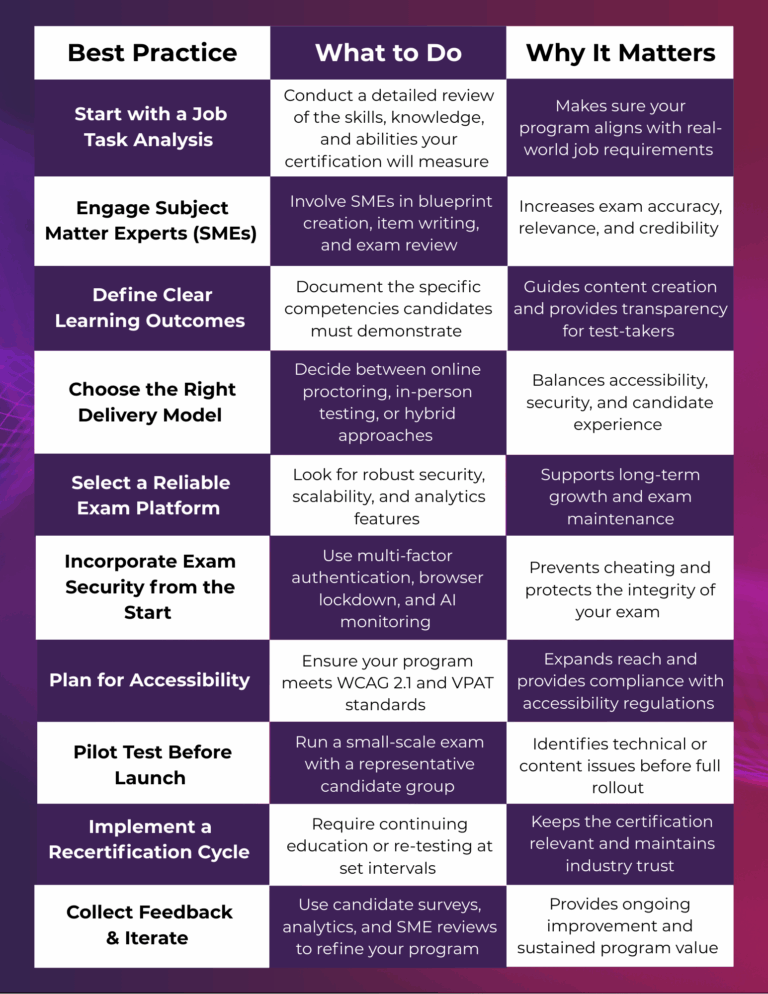
Before you dive into designing your certification program, it’s essential to follow proven best practices that provide long-term success. Use the checklist below as your guide.

The timeline varies depending on your program’s scope, complexity, and stakeholder resources. Typically, a full-cycle development (from job task analysis to launch) can take 6 to 12 months. Fast-track programs may launch in 3 to 4 months, while highly regulated, high-stakes programs might take longer. A phased rollout can help you scale efficiently, as discussed in our guide on scaling certification programs: From Chaos to Control: How to Scale Your Certification Program Effectively
Psychometrics ensures your exam measures accurately, consistently, and fairly. It involves statistical techniques to validate item performance, define passing standards, and maintain reliability across candidate populations. Incorporating psychometric rigor boosts your program’s credibility and defensibility while demonstrating a commitment to validity.
Certification programs can elevate user engagement and loyalty when aligned with broader business objectives. By offering certifications to customers, partners, or employees, organizations create ongoing value, driving both revenue and retention. Learn how to make your certification a strategic growth lever in our blog: How to Turn Certification Into a Revenue and Retention Strategy
Publishing and maintaining certification programs can be resource-intensive, unless you optimize for automation and flexibility. Using Kryterion’s no-cost publishing model reduces overhead and empowers teams to update items and launch exams faster. Learn how to streamline your process and reduce administrative burden in our blog: Revolutionizing Certification Programs: Kryterion’s No-Cost Publishing Advantage
While certifications validate expertise, they can also serve as recognition and motivation tools within your organization. By offering internal certifications, you signal investment in professional growth, which can boost morale, retention, and performance. Discover unexpected ways certifications enhance workplace culture in our article: The Psychology of Certification Programs: 5 Unexpected Ways to Elevate Employee Morale
Building a certification program is a strategic investment in your organization’s reputation, credibility, and growth. With the right partner, you can launch a certification program that scales globally and maintains the highest standards in your industry.
Ready to take the next step? Schedule a consultation with a Kryterion expert.
Certification programs can be an ROI positive tool for increasing product adoption and advocacy. 90% of companies have seen a positive return on their customer education investments, which can be enhanced with the addition of a certification (Forrester).
Certification programs can be an effective tool to drive customer retention which increases profitability. Increasing customer retention rates by only 5% increases a company’s profits by 25-95% (Harvard Business School).
Certification programs can build confidence in your product and credibility in your brand. 80% of consumers say they consider trust a deciding factor in their buying decisions (consumer survey).
Whether you're starting or growing your program, our team of experts can help you succeed. Contact us today for a free consultation.
Want more information? Fill out the form below and we’ll get back to you right away!