



Artificial intelligence is now woven into everyday business operations, often without much attention. It schedules interviews, reviews resumes, answers customer questions, flags unusual behaviors, and helps teams process more information than they ever could on their own.
Most enterprise AI today is not autonomous or futuristic. Rather, they are systems trained on large datasets to recognize patterns and surface probabilities. In many cases, these tools work as intended. They save time, reduce manual effort, and bring consistency to repeatable tasks.
The risk emerges when AI shifts from support to authority. As AI becomes more embedded in workflows, organizations may begin to accept outputs at face value without fully understanding how they were produced or when they should be questioned. That’s when blind spots form.
What AI Is Actually Doing Inside Organizations
Across industries, AI is commonly used to:
- Screen job applicants based on historical hiring data
- Flag potential fraud or policy violations
- Recommend next steps in customer service interactions
- Monitor online testing environments for irregular behavior
- Analyze performance data to guide decisions
In each case, AI is doing one thing well. It compares new inputs against existing patterns and highlights what appears typical or unusual.
What it does not do is understand intent, context, or consequence. It does not know why a resume was rejected, why a candidate appears nervous during an exam, or why a customer interaction feels unresolved. It calculates likelihoods, not meaning. That distinction matters.
Pattern Recognition Isn’t Judgment
Because AI outputs often appear confident and precise, they can easily be mistaken for conclusions rather than signals. A hiring model may rank certain candidates lower because similar profiles were hired less often in the past. An exam security system may flag behavior that looks irregular but is harmless. Or, a chatbot may provide an answer that is technically correct but unhelpful in the moment.
In each case, the system is functioning as designed. The issue arises when recommendations are accepted without considering the surrounding context.
Bias Doesn’t Disappear. It Scales.
AI does not create bias on its own. It reflects the data it is trained on.
If historical data includes unequal access, inconsistent evaluation, or outdated assumptions, AI can reinforce those patterns efficiently and quietly. As automation increases, it can become harder to see where those outcomes originate.
For example, a certification program that has historically served a narrow audience may train systems to flag unfamiliar environments or behaviors as risky, even when they are not. Without human review, those signals can lead to unintended consequences.
Human oversight is what turns data into responsible decision-making.
When Automation Replaces Judgment
As AI systems improve, it can feel easier to trust them without question. Over time, reviewing outputs may seem unnecessary or inefficient. This is how judgment gradually erodes.
When people stop questioning recommendations, they also stop learning from results. Errors take longer to surface and correcting them becomes more difficult. AI should reduce friction, not remove responsibility.
Accountability Still Belongs to People
Even when AI is part of the process, accountability remains with the organization.
If a candidate challenges a testing decision, a hiring outcome is questioned, or an automated response is disputed, someone must be able to explain what happened. That requires understanding how the system works, where it fits in the workflow, and when human review occurs.
AI can inform decisions. It cannot own them.
AI Doesn’t Evolve as Fast as the World Does
AI systems reflect the data and conditions they were trained on. The environments they operate in change constantly.
Regulations shift. User behavior evolves. New risks emerge. Without regular evaluation, performance can drift while confidence in the system remains high.
Routine reviews and updates are not signs of uncertainty. They are part of using AI responsibly.
Transparency Builds Confidence
People are more likely to trust systems they can understand. Clear explanations help even difficult outcomes feel fair. Opaque systems do the opposite. This is especially true in high-stakes environments like certification, testing, and professional advancement.
Transparency isn’t optional. It’s foundational.
A More Balanced Approach
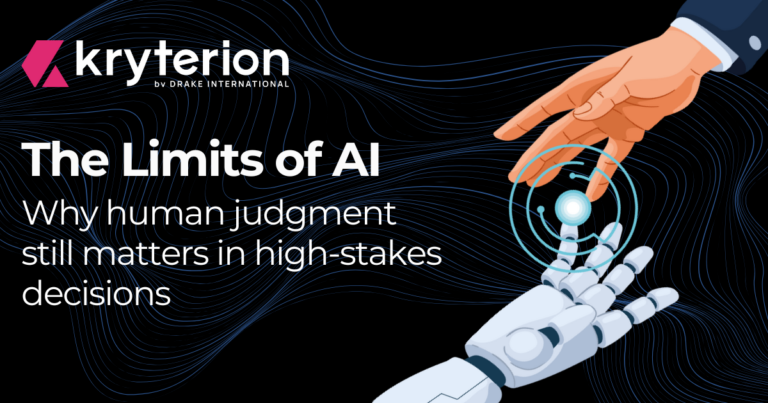
AI delivers the most value when paired with human judgment. Organizations that use it well are clear about where automation helps, where people decide, and how outcomes are reviewed. AI becomes a tool that supports decisions rather than replaces them.
That balance allows organizations to scale efficiency without scaling risk.
Final Thought
AI is powerful because it processes information quickly and consistently. It is also limited because it lacks context, intent, and accountability.
Organizations that recognize both sides get more from the technology. Not by stepping back from AI, but by staying actively involved and intentional about how it is used.
At Kryterion, AI is designed to support decision-making, not replace it. We pair AI-driven insights with human review, clear processes, and transparency so organizations understand what the technology is doing and why it matters.
That balance helps protect integrity, reduce risk, and build trust across high-stakes programs.
Good decisions still require people.