



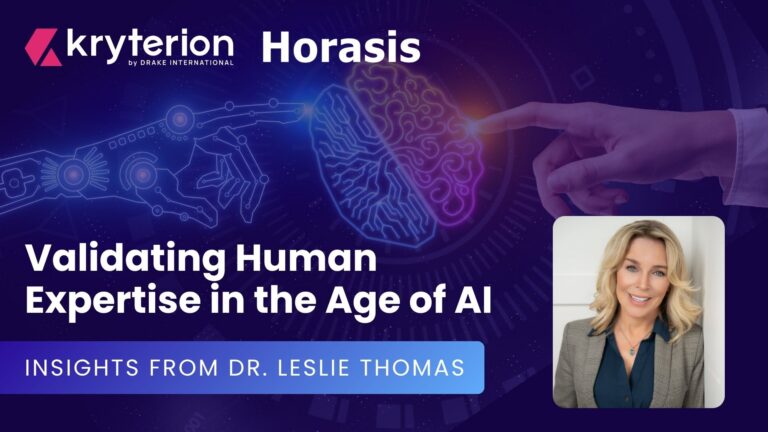
In her Horasis feature, Leslie Thomas, PhD, Chief Psychometric Officer at Kryterion, delivers a sharp, research‑driven examination of how artificial intelligence is reshaping the credibility and future of professional credentials. Her central argument is clear: AI isn’t making credentials obsolete; it’s forcing them to evolve.
Core Insight
AI is not diminishing the importance of credentials — it’s raising the bar.
In a world where generative AI is used by 75% of knowledge workers and can automate up to 70% of routine tasks, the credibility of a credential now hinges on its ability to verify real, durable, human skills.
Read the full piece here: Keeping Credentials Credible in the Age of AI.
AI Is Reshaping What “Credibility” Means
AI’s rapid acceleration has exposed weaknesses in traditional academic pathways. Leslie outlines how the rise of AI‑assisted cheating, declining trust in degrees, and the automation of routine cognitive tasks are forcing institutions to rethink how they measure competence.
She notes that while degrees once served as broad indicators of readiness, employers are now demanding proof of specific, job‑relevant skills — and they want that proof to be validated through defensible, psychometrically sound methods.
Key pressures driving this shift include:
AI‑enabled academic dishonesty undermining traditional assessments
Employer skepticism toward degrees, with public confidence dropping sharply
Automation of knowledge work, reducing the value of purely theoretical learning
A global pivot toward skills‑based hiring, especially in technical and regulated fields
These forces are accelerating the move toward certifications and performance‑based assessments that can withstand scrutiny in an AI‑augmented world.
Why Certifications Are Becoming More Valuable
Leslie emphasizes that certifications are not just surviving, they’re gaining influence. Unlike degrees, certifications can be updated quickly, aligned tightly to job roles, and validated through secure, proctored environments.
Employers increasingly view them as a more accurate signal of readiness, especially in fields where technology evolves faster than academic curricula.
Certifications are rising because they:
Validate real-world, job-specific competencies
Adapt quickly to emerging technologies and AI‑driven workflows
Reinforce ethical and secure testing practices
Emphasize durable human skills such as creativity, adaptability, and analytical reasoning
This shift reflects a broader truth: the future workforce must excel at collaborating with AI, not competing against it.
The Future: Modular, AI‑Enhanced, and Human‑Led
Leslie predicts a credentialing ecosystem that is more flexible, more data‑driven, and more responsive to industry change. Exams should be delivered in proctored settings where human oversight and AI monitoring can work together. Drawing on her psychometric expertise, Leslie outlines the structural elements that make a credential credible in the age of AI. She argues that rigor, defensibility, and alignment with real job tasks are non‑negotiable.
A credential’s value is no longer defined by prestige. It’s defined by validity, security, and relevance.
In short, AI will accelerate credentialing, but humans will safeguard its integrity.
To explore Leslie’s full analysis, visit: Keeping Credentials Credible in the Age of AI.
About Leslie Thomas, PhD
As Chief Psychometric Officer at Kryterion, Leslie Thomas leads the development of secure, scientifically rigorous assessment programs used worldwide. Her work ensures that credentials remain trustworthy, future‑ready, and aligned with the evolving demands of an AI‑driven workforce. Learn more about Kryterion’s Psychometric team.