For Credentialing Directors and Managers, the transition to online proctoring often feels like an inevitability. You see the immediate operational benefits, including wider reach, reduced logistical headaches, and a more modern experience for your candidates. Particularly for mid- to low-stakes testing programs, such as foundational IT certifications, professional association certificates, or corporate compliance assessments, the shift away from exclusive brick-and-mortar test centers is a natural evolution.
However, seeing the value yourself and proving it to your stakeholders are two entirely different challenges. Subject Matter Experts (SMEs), test development committees, and executive boards are fiercely protective of the credential’s reputation. Their concerns are predictable but valid:
- Will candidates cheat?
- Will our certification lose its prestige?
- Is the technology reliable enough?
- Do scores from a living room mean the same thing as scores from a secure test center?
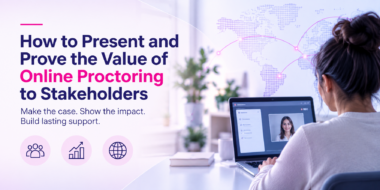
To win their buy-in, you cannot rely on promises of convenience. You need a practical, data-backed blueprint that demonstrates how modern online proctoring maintains exam integrity, preserves psychometric validity, sustains public trust, and dramatically improves candidate access.
If you are currently building a business case for online proctoring, here is how you can structure your argument to address stakeholder fears and secure their approval.
Pillar 1: Defending Exam Integrity Through Multi-Level Security and Human Oversight
The most immediate objection from any executive board or test development committee is the fear of widespread cheating. For stakeholders who envision online testing as an unmonitored free-for-all, your first objective is to demystify how modern remote proctoring actually works.
To overcome pushback, you must frame online proctoring not as a compromise on security, but as an evolution of it. Start by breaking down the security layers for your stakeholders:
- Identity Verification: Before a test even begins, candidates must pass biometric keystroke analysis, facial recognition, and ID verification to make sure the person taking the exam is the person who registered.
- Environmental Securitization: Explain the concept of the environmental scan and browser lockdown. The technology restricts candidates from opening new tabs, using unauthorized applications, or utilizing dual monitors.
- AI-Assisted Flagging: Modern systems use artificial intelligence to monitor eye movement, background noise, and secondary devices. However, make it clear to your stakeholders that AI does not make the final judgment.
- Professional Human Oversight: This is the anchor of your security argument. Assure your board that highly trained, professional human proctors are actively reviewing AI-flagged anomalies or monitoring the candidate in real-time.
By presenting data on how multi-level security successfully deters, detects, and prevents academic dishonesty, you reassure stakeholders that public trust in the credential will remain unshakeable.
Pillar 2: Psychometric Validity
While executive boards worry about brand reputation, your test development committees and psychometricians worry about score validity. Their primary concern is whether the testing modality introduces construct-irrelevant variance. This means that a less controlled environment, rather than the candidate’s knowledge, is impacting the score.
If remote candidates score significantly higher or lower than test center candidates, the validity of the credential could be compromised. To address this, you need to show that performance data remains consistent regardless of where the exam is delivered.
Zach Irwin, Senior Psychometrician at Kryterion, frequently works with credentialing bodies to navigate this exact hurdle. He explains how data can neutralize the most stubborn pushback:
“The most common pushback we see from subject matter experts and test development committees is the assumption that remote delivery inherently degrades the value of the exam. To satisfy these criticisms, we suggest ensuring security between test centers and remote delivery is made as close as possible. With comparable security and delivery settings in place, remotely delivered test sessions can be reasonably demonstrated to approximate the same level of competency as scores captured via test center deliveries.”
Pillar 3: Driving Efficiency with GTM Time Reduction and Operational Scalability
Once you have satisfied the security and psychometric concerns, you must pivot to the business case. For mid- to low-stakes testing programs, agility and growth are often top priorities. Stakeholders care deeply about the bottom line, and online proctoring offers a distinct competitive advantage.
Go-To-Market (GTM) Time Reduction: Launching a new certification or updating an existing exam in a traditional brick-and-mortar model can be potentially slow. You have to coordinate with a global network of test centers, secure physical seat time, and navigate blackout dates.
Online proctoring fundamentally changes this timeline. Without the bottleneck of physical capacity, your GTM time is drastically reduced. Highlight to decision makers that faster GTM means faster time-to-revenue and a stronger position as an agile, market-responsive credentialing body.
Operational Scalability: In addition to speed, emphasize scalability. Growing a testing program traditionally requires localized marketing, hoping that candidates live within driving distance of a testing facility.
Online proctoring scales infinitely. Whether your program sees an influx of 100 candidates or 10,000 candidates following a successful marketing campaign, remote proctoring infrastructure can absorb the volume without a hitch. Additionally, you are no longer constrained by the operating hours or seat limits of physical locations.
Pillar 4: Technical Trust, System Reliability, and Expanding Candidate Access
The final hurdle in your presentation is the perceived friction of the candidate experience. Stakeholders will inevitably ask what will happen if the system crashes. To counter this, your blueprint must provide hard system reliability data.
When presenting to the board, come equipped with metrics, including uptime, the average time-to-connect, and the minimal bandwidth requirements needed to run the software. Furthermore, detail the embedded technical support available to candidates. Finally, tie this technical reliability directly to candidate access and equity.
For mid- to low-stakes programs, such as entry-level software certifications or introductory professional credentials, accessibility is crucial for growing your candidate pipeline. Traveling to a physical test center requires time off work, reliable transportation, and childcare. For rural or international candidates, a physical test center might be hundreds of miles away.
Online proctoring democratizes access. By removing geographical, logistical, and socioeconomic barriers, you are expanding your total addressable market. When you frame online proctoring as an engine for diversity, equity, and inclusion, you tap into the core mission of most credentialing associations, which is empowering professionals to advance their careers, regardless of where they live.
Partnering for Success: The Kryterion Advantage
When searching for a partner to bring this blueprint to life, credentialing leaders frequently look to established solutions like Kryterion. Kryterion’s Webassessor platform provides a real-world example of how to balance stringent exam security with seamless candidate access.
Here is how Kryterion’s online proctoring capabilities align with stakeholder requirements:
- Multi-Layered Security Protocols: Kryterion’s Webassessor platform ensures only verified candidates access the test through authentication methods like government-issued IDs, facial recognition, and biometric keystroke verification. During the exam, secure browser lockdown technology is enforced to restrict unauthorized on-screen access.
- AI and Human Synergy: To maintain exam integrity, Kryterion combines AI-enhanced technology with live human proctoring. The AI seamlessly monitors patterns like unusual eye movements or changes in the testing environment, while a live human proctor actively monitors the session in real time, ready to intervene if suspicious behavior is flagged.
- Limitless Scalability: Kryterion enables credentialing bodies to scale globally as testing demand increases. With 24/7 availability, candidates are empowered to test whenever they are ready instead of waiting for open test center slots.
- Commitment to Accessibility: To truly expand candidate pipelines, testing must be equitable. Kryterion’s platform meets WCAG 2.1 and VPAT standards, actively supporting custom accommodations like screen reader compatibility, alternative input devices, and extended time limits to ensure every candidate has a fair opportunity.
Integrating a recognized solution like Kryterion into your business case provides your stakeholders with tangible proof that the shift to online proctoring is a secure, scalable, and inclusive evolution for your credential.
Moving Forward with Confidence
Transitioning to online proctoring is a significant operational shift, but for mid- to low-stakes credentialing programs, it is a necessary step to remain relevant, accessible, and financially healthy. By utilizing a data-backed approach that proves multi-level security, showcases psychometric score equating, highlights operational scalability, and guarantees high system reliability, you transform online proctoring from a perceived risk into a strategic imperative.
You no longer have to ask your stakeholders to take a leap of faith. With the right data and the right technology partner like Kryterion, you can prove the value of online proctoring and confidently guide your credentialing program into the future.
About Kryterion
Kryterion Inc. is a global leader in innovative testing and credentialing solutions. We help organizations across various sectors develop and manage their assessments with our advanced test development platform and multi-modal delivery solutions. Established in 2001 Kryterion offers secure and integrated services along with extensive support. This empowers candidates to demonstrate skills and achieve success in world class careers.